
Fish gasping at the surface? Dead fish floating? Don't panic — but move fast. Here's exactly what to do, step by step.
More than 90% of summer fish kills are caused by an abrupt drop in dissolved oxygen (DO), often coupled with a spike in toxic ammonia. The window between "stressed fish" and "dead fish" can be measured in hours — sometimes minutes. The largest fish die first because they have the highest oxygen demand. Here's your action plan.
Look for these signs that a DO crash is in progress or imminent. If you see any two of these at the same time, treat it as an emergency:
Large fish gulping at the surface near inflows or aerator boils ("piping"). A strong earthy or sulfur smell coming off the water. Sudden improvement in water clarity after a period of green water — the algae have died and are now decomposing. Any dead or dying fish, regardless of number. A DO meter reading below 4 mg/L anywhere in the water column.
If you have a DO meter, use it now. If you don't, act on the visual and olfactory signs — don't wait for a test kit.
If you have a surface aerator: Turn it on immediately if it's not already running. If you have more than one unit, get every available aerator in the water. Position them to maximize surface disturbance across the widest area possible.
If you don't have a surface aerator: Order one now — we keep them in stock for immediate purchase. Our go-to emergency recommendation is the Kasco 4400AF (1 HP) — it covers 1 to 2 acres, delivers up to 3 lbs of O₂ per hour, and can be unpacked, assembled, and running in under 20 minutes. It's the sweet spot between coverage and plug-and-play simplicity. As a general rule, plan for 1 HP per surface acre.
Last-resort emergency measure — the trash pump method: If you cannot get an aerator immediately, a gas-powered trash pump can buy critical time. Set the intake at mid-depth, at least 24 inches off the bottom — you do not want to pull sediment and add biological oxygen demand to an already oxygen-starved system. Attach a fire-hose style nozzle to the discharge and arc it as high into the air as possible, allowing the water to cascade back into the pond. The goal is maximum air-water contact as the spray falls. Run it continuously through the night. Overnight — from sunset to sunrise — is when DO is at its lowest because algae stop producing oxygen but every organism in the pond keeps consuming it.
This is a modestly effective approach at best, but it's dramatically better than doing nothing.
⚠ Do NOT start a bottom diffused aeration system during an active emergency. If it's not already running, don't turn it on now. Aggressive bottom mixing when DO is critically low can stir anoxic sludge — loaded with hydrogen sulfide, ammonia, and oxygen-consuming organic matter — into the water column, making conditions dramatically worse. This is essentially triggering the very event you're trying to prevent. Surface aeration is the only safe emergency response.
If fish are dying, ammonia is almost certainly part of the problem. Dead and dying organic matter releases ammonia as it decomposes, and if anoxic bottom water has mixed into the water column, accumulated ammonia comes with it. Converting just 1 mg/L of ammonia to nitrate requires approximately 4 mg/L of dissolved oxygen — so an ammonia spike creates a cascading oxygen demand on top of an already depleted system.
Apply RapidBac to accelerate biological ammonia conversion. RapidBac delivers concentrated nitrifying bacteria that rapidly convert toxic ammonia to less harmful nitrate. This takes chemical oxygen demand pressure off the system and directly reduces the compound that's most toxic to fish at high pH.
If the crisis was triggered by a massive algae bloom, dense green water, or visible cyanobacteria, there is almost certainly a large phosphorus load in the water column. As algae cells die, they release their stored phosphorus — which immediately becomes available to fuel the next bloom. Without intervention, you'll be right back in crisis within days.
Apply MetaFloc to bind dissolved phosphorus and remove it from the water column. MetaFloc is a biological phosphorus binder that locks phosphorus at the sediment surface, breaking the bloom-crash-bloom cycle. Use the MetaFloc Dosing Calculator to determine the right rate for your situation, or call us and we'll walk you through it.
Once you've got aeration running, call us. Our Pond Experts can help you assess the situation, determine the root cause, and build a recovery plan. We've been through this hundreds of times and we can help you save what's left and prevent it from happening again.
Natural Waterscapes Technical Support: (877) 493-7660
If you can, have the following ready when you call: pond size (acres), approximate depth, whether you have any aeration equipment, a rough description of what the water looks like, and how many fish (and what size) you've found dead or stressed.
A fish kill rarely comes out of nowhere. Learning to read the early warning signs can mean the difference between a close call and a catastrophe. Here's what to watch for, roughly in order of urgency:
The Overnight Rule: The most dangerous period for any pond is between sunset and sunrise. Photosynthesis stops, but respiration continues. If you see any warning signs in the late afternoon or evening, do not wait until morning to act. Get aeration running before dark and keep it running through the night.
In a fish kill emergency, oxygen is everything. A properly sized surface aerator is the fastest, safest, most effective tool a pond owner can deploy. Here's why — and how to use one.
During a DO crash, fish crowd the upper 12–18 inches of the water column where the last traces of oxygen remain. A surface aerator attacks the problem right where the fish are: it violently breaks the surface tension, entrains atmospheric air into the water, and pushes oxygenated water laterally across the pond. High-efficiency units like the Kasco AF series can deliver up to 3 pounds of oxygen per horsepower per hour — the highest transfer efficiency of any portable aeration technology.
A 1 HP unit can raise DO in a one-acre pond by roughly 1 mg/L in under two hours. That's often the difference between a kill in progress and a close call. Surface aerators are plug-and-play: a Kasco AF series unit can be unpacked, assembled, and running in under 20 minutes.
As a general rule of thumb, plan for 1 HP of surface aeration per surface acre of pond. For emergency situations, more is better — if you have access to multiple units, deploy them all. We keep Kasco AF series aerators in stock for immediate purchase and fast shipping.
Our go-to emergency recommendation is the Kasco 4400AF — 1 HP. It covers 1 to 2 acres, can raise DO by roughly 1 mg/L in under two hours, and is the right balance of power and plug-and-play simplicity. The full AF lineup:
2400AF — 1/2 HP (ponds under 1 acre) · 3400AF — 3/4 HP · 4400AF — 1 HP ★ · 8400AF — 2 HP (2+ acres)
For larger ponds and lakes, the 3 HP and 5 HP Kasco surface aerators provide coverage for multi-acre bodies of water.
If you cannot get a surface aerator immediately, a gas-powered trash pump can buy critical time overnight. The full setup is described in Step 2 of the triage plan above — the key points are: intake at least 24 inches off the bottom (never pull sediment), arc the discharge as high as possible through a fire-hose nozzle, and run it without interruption from sunset to sunrise.
Bottom diffused aeration systems are excellent long-term management tools. They circulate the full water column, prevent stratification in deeper ponds, and keep sediments oxygenated. But they are the wrong tool for an emergency, for two important reasons.
First, they work slowly. A bottom diffused system can take 48–96 hours to generate significant oxygen improvement throughout the water column because it relies on lifting cold bottom water to the surface — a gradual mixing process. In an emergency, you don't have days. You may not have hours.
Second — and more dangerously — starting a bottom system in a pond with an anoxic bottom layer can release accumulated hydrogen sulfide, ammonia, and oxygen-consuming organic compounds all at once. You are essentially forcing a mixing event identical to the storm-driven turnover that causes fish kills in the first place. The recommended approach for bottom diffused systems is to start gradually during stable conditions, running short intervals and increasing over one to two weeks.
Surface aerators bypass both problems. They work at the air-water interface where stressed fish are concentrated, they deliver oxygen within minutes, and they do not disturb the sediment layer.
Aeration addresses the immediate oxygen crisis. But the underlying chemistry — ammonia, phosphorus, and biological oxygen demand — needs to be treated simultaneously to prevent the situation from cycling right back.
Ammonia is one of the most dangerous compounds in a fish kill event. It comes from two sources: decomposition of dead organic matter (including dead fish themselves), and the release of accumulated ammonia from anoxic sediments when the water column mixes. At high pH — above 8.5, which is common in productive ponds during the afternoon — a greater proportion of total ammonia exists in its toxic unionized form (NH₃). Even a modest ammonia concentration at high pH can be lethal.
Apply RapidBac as soon as possible. RapidBac delivers concentrated nitrifying bacteria that convert ammonia (NH₃/NH₄⁺) to nitrite and then to nitrate (NO₃⁻), which is far less toxic. This biological conversion is the same process that happens naturally in a healthy pond, but RapidBac accelerates it dramatically when the native bacterial population has been overwhelmed.
If the event was driven by an algal bloom — particularly if cyanobacteria was present — there is a massive phosphorus load in the water column. Every algae cell that dies releases its stored phosphorus back into the water, creating immediate fuel for the next bloom. Without binding that phosphorus, you'll be fighting the same crisis repeatedly.
Apply MetaFloc to bind dissolved phosphorus and remove it from the water column. MetaFloc forms a biological cap on the sediment surface that locks legacy phosphorus in place. For emergency dosing rates, use the MetaFloc Dosing Calculator or call us directly.
A note on algaecides: Be extremely cautious about killing a large algae bloom with algaecide during or immediately after a fish kill. Rapidly killing dense algae creates an enormous decomposition oxygen demand that can trigger a second DO crash worse than the first. If algaecide treatment is necessary, treat no more than one-third of the pond at a time, ensure aeration is running before and during treatment, and follow up with MetaFloc to capture the phosphorus released from dying cells. In many acute situations, binding the phosphorus first with MetaFloc is safer than killing the bloom directly.
As soon as the immediate crisis is stabilized, get a water sample tested. At minimum, you need dissolved oxygen, ammonia, pH, and phosphorus levels. These four parameters tell you the full story of what happened and what needs to happen next.
Our Pond Water Testing Service provides comprehensive analysis with specific treatment recommendations based on your results. In an emergency, a basic ammonia test kit and a DO meter are the most valuable field tools you can have.
A sudden, dense algae bloom isn't a fish kill — yet. But it's the setup for one. Heavy blooms produce enormous oxygen swings: supersaturation during the day, potentially lethal lows overnight. And when the bloom eventually crashes — whether from weather, self-shading, or nutrient depletion — the decomposing biomass creates a massive oxygen demand that can tip the system into crisis within hours.
A rapid algae bloom typically signals a pulse of phosphorus — from stormwater runoff, sediment release during a mixing event, or accumulated internal loading. That phosphorus fuels explosive growth of phytoplankton, sometimes reaching densities that limit Secchi visibility to under 12 inches. If the bloom is dominated by cyanobacteria (blue-green algae), the problem is worse: cyanobacteria produce toxins, are largely inedible to zooplankton, and form dense surface scums that block light to the rest of the water column.
Keep aeration running. Continuous surface aeration helps buffer the overnight oxygen crash that follows a dense bloom. This is not optional — it is the single most important thing you can do while you assess the situation.
Bind the phosphorus. Apply MetaFloc to remove dissolved phosphorus from the water column. Starving the bloom of its fuel source is safer and more sustainable than killing it with algaecide. MetaFloc also forms a cap on the sediment that prevents further phosphorus release from the bottom.
Do NOT panic-dose algaecide. Killing a heavy bloom all at once creates a decomposition oxygen demand that can trigger a fish kill. If you must treat, work in thirds — treat one section of the pond at a time, with aeration running, and wait for the decomposition to clear before treating the next section.
Test the water. A water test will confirm phosphorus levels and help determine the right treatment rate. It will also reveal whether cyanobacteria toxins are a concern for pets, livestock, or people who may be in contact with the water.
Dissolved oxygen and temperature trends warn you before a crisis. Track them in MyPond so you catch danger early — the difference between a close call and a catastrophe.
Know Your Pond — Start Free → See the Slab Lab's live DO & video now → Free for up to 3 ponds · No credit card requiredIf your DO meter shows readings trending below 4 mg/L but you haven't lost fish yet, you are in the prevention window. Watching a real pond's numbers helps you calibrate — you can see the Slab Lab's dissolved oxygen live. This is the time to act aggressively and prevent a crisis from becoming a catastrophe.
Warm-water species (bass, bluegill, catfish) begin showing stress behavior below 4 mg/L of dissolved oxygen. Below 3 mg/L, mortality begins rapidly — and the largest, most valuable fish die first because they have the highest metabolic oxygen demand. The space between "low DO" and "dead fish" can collapse in a matter of hours, especially overnight when photosynthetic oxygen production stops completely.
If you're measuring low DO in the late afternoon or evening, the situation will get worse before it gets better. You have until sunrise to prevent a kill.
Aerate immediately and continuously. Get every available surface aerator running. If you don't have one, this is the moment to act — order one now, or deploy the trash pump method described in the triage section above. Run aeration through the night without interruption.
Identify the cause. Low DO doesn't happen in isolation. Common triggers include a dense algae bloom approaching a crash, consecutive overcast days suppressing photosynthesis, a recent herbicide or algaecide application killing vegetation that's now decomposing, or a weather event that mixed the water column.
Reduce oxygen demand. If you're feeding fish, stop feeding immediately. Every pound of fish feed adds biological oxygen demand. If there's visible dead vegetation or organic matter accumulating, the decomposition is consuming oxygen. Apply Pond Cleanse to accelerate aerobic decomposition — but only if aeration is running to support the bacterial activity.
Monitor through the night. If possible, check DO readings at sunset, midnight, and pre-dawn (5:00–6:00 AM). The pre-dawn reading is the most important — it represents the absolute lowest oxygen point of the 24-hour cycle. If you can keep pre-dawn DO above 3 mg/L, you'll likely avoid a kill.
Dissolved oxygen in a pond follows a predictable daily (diel) cycle driven by photosynthesis and respiration. During daylight hours, algae and aquatic plants produce oxygen — sometimes pushing DO to supersaturation levels (above 12–15 mg/L in heavily productive ponds). But at night, photosynthesis stops completely while every living organism in the pond — fish, bacteria, algae, invertebrates — continues consuming oxygen through cellular respiration.
In a well-balanced pond, the nighttime drawdown is modest and DO stays well above stress thresholds. In a nutrient-loaded pond with heavy algal biomass, the nighttime respiration demand can be enormous. The more algae the pond grows during the day, the more oxygen it consumes at night. This is the paradox of "productive" green water: the same biomass that pushes DO to 15 mg/L at 3:00 PM can drag it below 2 mg/L by 5:00 AM.
Warm water makes everything worse. At 90°F, water can only hold about 7 mg/L of dissolved oxygen at saturation — compared to 11 mg/L at 50°F. The storage capacity is reduced at precisely the time when biological demand is highest. This is why late summer, after weeks of heat and nutrient loading, is the highest-risk period for DO crashes.
Aeration doesn't just add oxygen — it provides a mechanical buffer against the diel cycle. Continuous surface aeration transfers atmospheric oxygen into the water around the clock, supplementing what photosynthesis can't provide after dark. It's the single most impactful intervention a pond owner can make for fish safety.
Ammonia is a silent accelerant in pond emergencies. It doesn't color the water or produce an obvious visual cue, but it compounds every other problem — and at high pH, even modest concentrations become lethal to fish.
Ammonia accumulates in a pond through several pathways. In anoxic sediments, decomposing organic muck produces ammonia that builds up at the bottom as long as the sediment layer remains oxygen-depleted. Fish excrete ammonia continuously as a metabolic waste product. Dead fish, dead algae, grass clippings, leaf litter, and uneaten fish feed all release ammonia as they decompose. And in heavily stocked or fed ponds, the cumulative ammonia load can be substantial even under normal conditions.
The most dangerous scenario is when a mixing event pulls accumulated sediment ammonia into the water column all at once. This is what happened at the Slab Lab — the storm-driven mixing brought ammonia off the bottom that exerted a massive chemical oxygen demand on the entire system, compounding the DO crash and pushing already-stressed fish past the point of survival.
Total ammonia in water exists in two forms: ionized ammonium (NH₄⁺), which is relatively non-toxic, and unionized ammonia (NH₃), which is highly toxic to fish. The proportion of each form is determined almost entirely by pH and temperature. At pH 7.0, less than 1% of total ammonia is in the toxic unionized form. At pH 9.0 — not uncommon in a productive pond during the afternoon when photosynthesis drives pH up — over 30% is unionized.
This means that the same total ammonia concentration can be relatively safe at dawn (when pH is lower) and acutely lethal by mid-afternoon (when pH peaks). Ammonia toxicity is a moving target, and pH is the lever that controls it.
Apply RapidBac. RapidBac delivers concentrated nitrifying bacteria that convert toxic ammonia to nitrate through the biological nitrification pathway. This is the same process that occurs naturally in a healthy pond, but RapidBac dramatically accelerates it when the native bacterial population has been overwhelmed by a sudden ammonia surge.
Maintain aeration. Nitrification is an aerobic process — the bacteria that convert ammonia require dissolved oxygen to function. Without aeration, the ammonia conversion stalls, and you lose both the oxygen and the ammonia treatment simultaneously.
Remove dead fish. Every dead fish in the pond is a source of ongoing ammonia production. Remove as many dead fish as you can reach. This reduces the continuing ammonia load and also helps you estimate the scale of the loss.
Stop feeding. If you're actively feeding fish, stop immediately. Fish feed that isn't consumed decomposes and adds both ammonia and BOD. Even consumed feed results in ammonia excretion. Eliminating feed inputs reduces the total ammonia burden on the system.
These are the tools and treatments that matter most in a pond emergency. Having them on hand before a crisis is the best insurance a pond owner can buy.
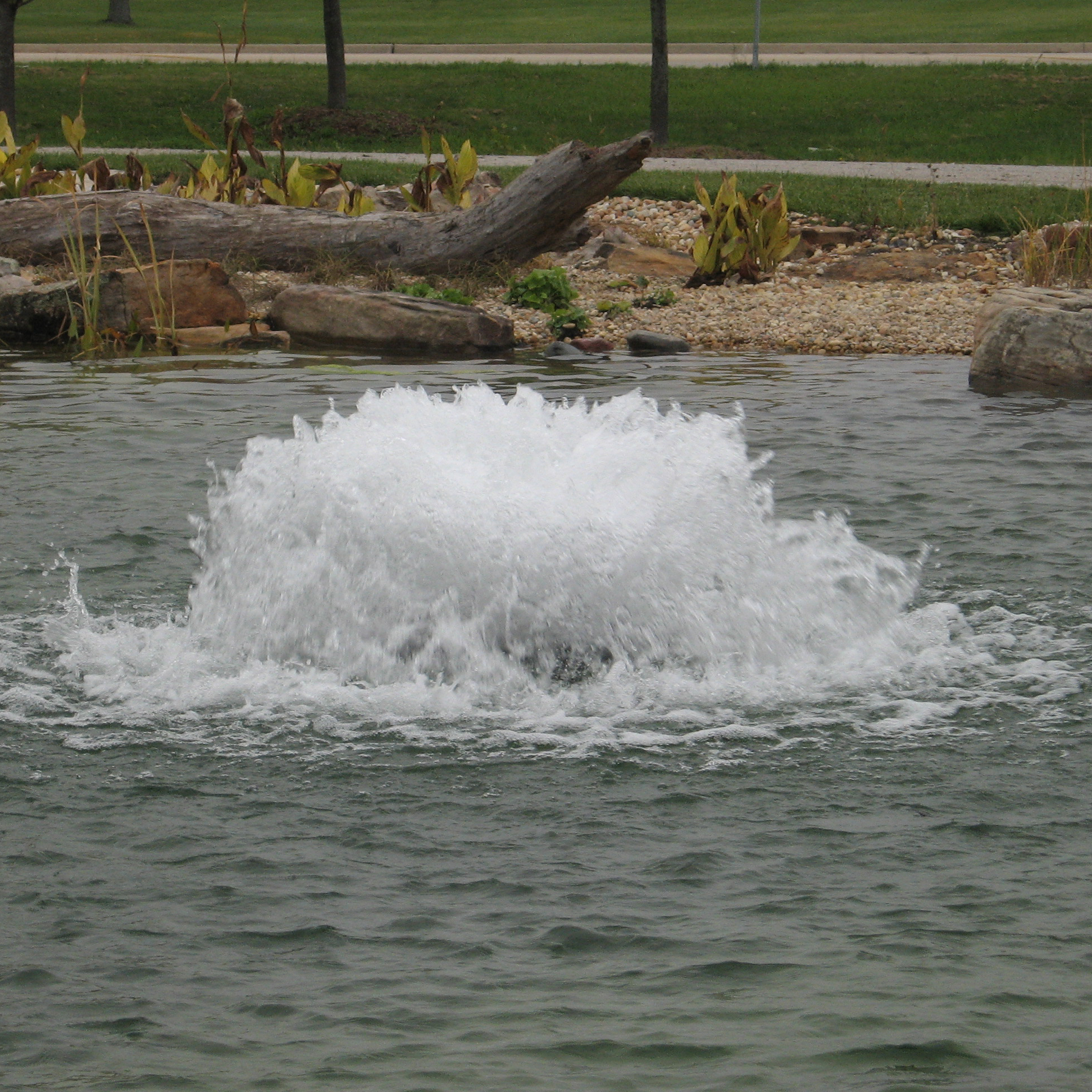
Our #1 emergency recommendation. Up to 3 lbs O₂/HP/hr. Plug-and-play in under 20 min. In stock — ships fast.
Buy Now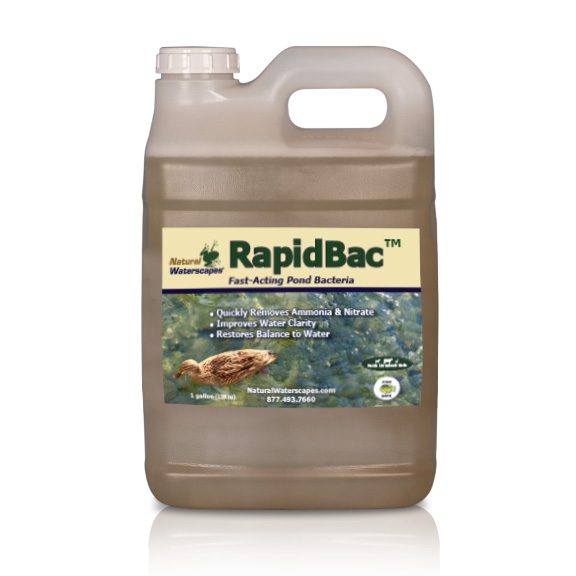
Concentrated nitrifying bacteria for emergency ammonia conversion. Accelerates the natural nitrification cycle.
Shop RapidBac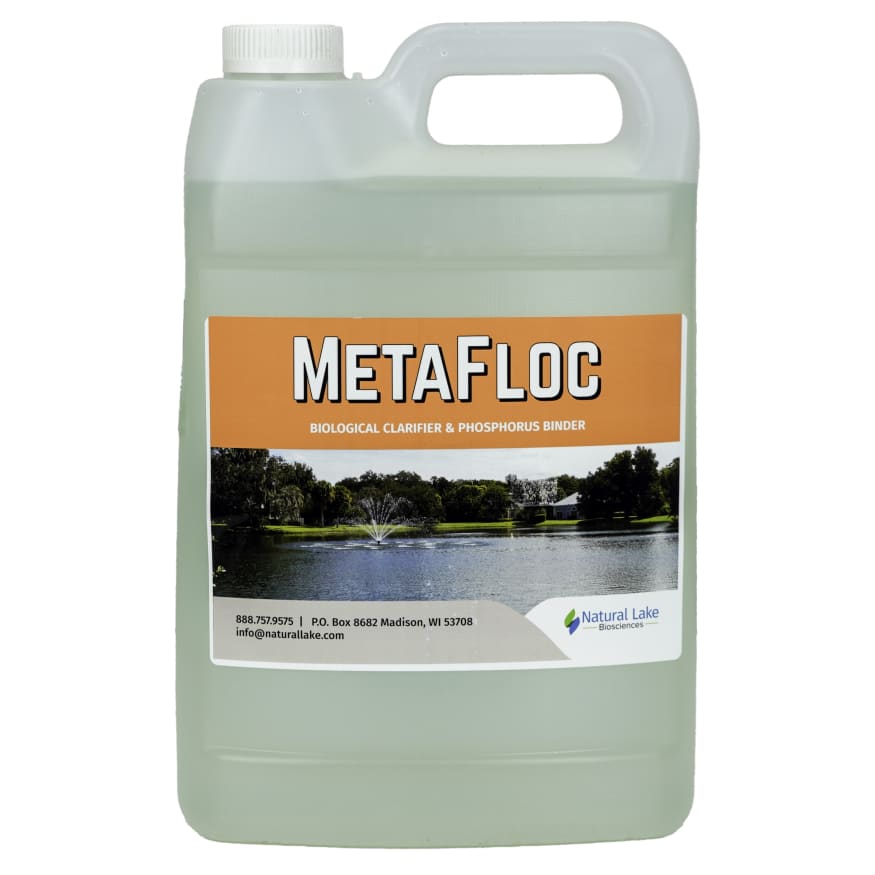
Biological phosphorus binder. Removes dissolved phosphorus and caps sediment to break the bloom cycle.
Shop MetaFloc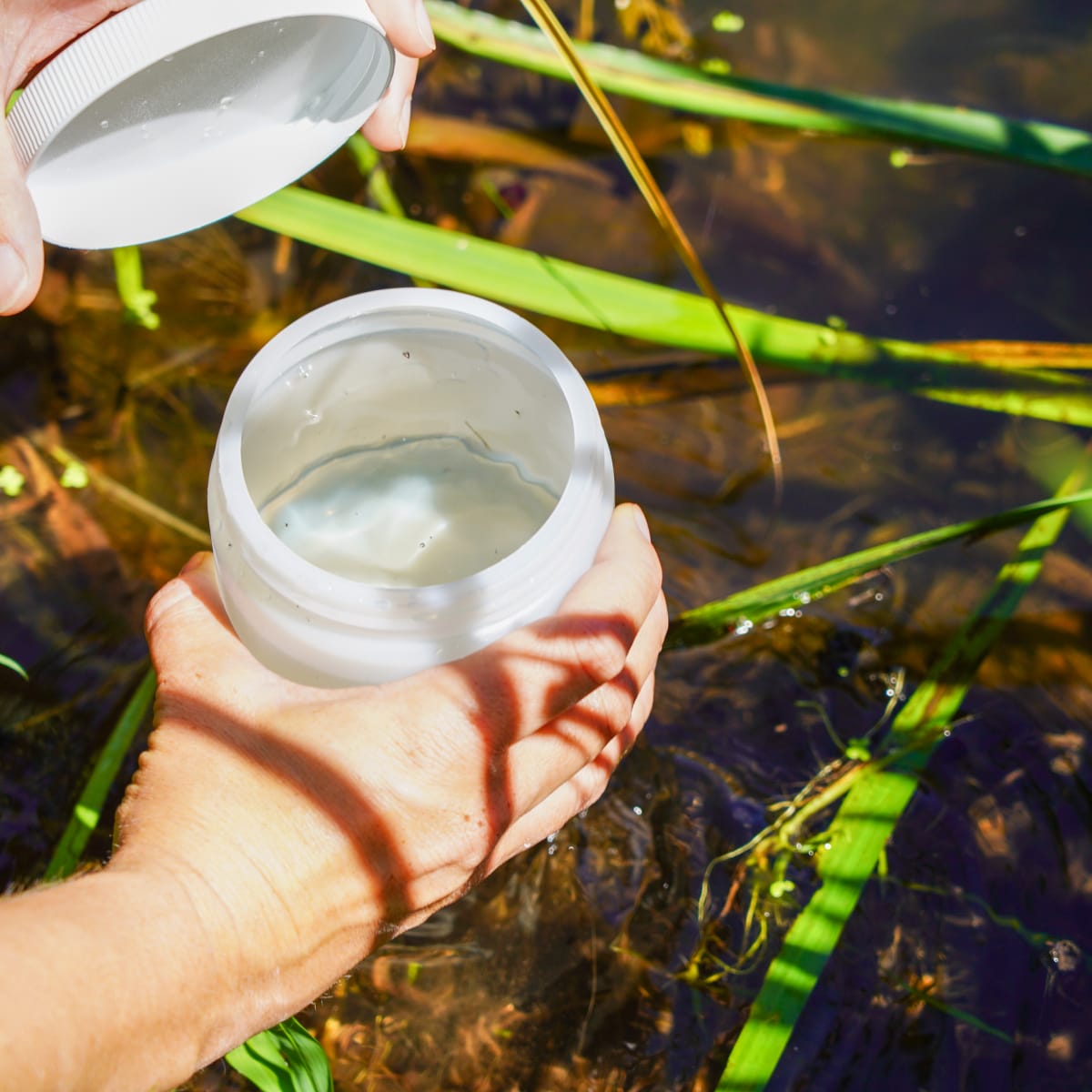
Comprehensive water analysis with specific treatment recommendations based on your results.
Order Test KitUse code SLABLAB at shop.naturalwaterscapes.com for $20 off orders over $100.
Get oxygen into the water immediately. If you have a surface aerator, turn it on now. If you don't, order one — we keep them in stock for immediate purchase. Our go-to recommendation is the Kasco 4400AF (1 HP), which covers 1–2 acres and can be running in under 20 minutes. If you can't get an aerator right away, a trash pump can buy time: intake at mid-depth (at least 24 inches off the bottom), fire-hose nozzle arced high, run it continuously overnight. Then call us at (877) 493-7660 for next steps.
During the day, algae and aquatic plants produce oxygen through photosynthesis. At night, that process stops — but every organism in the pond continues to consume oxygen. In nutrient-rich ponds with heavy algal biomass, this nighttime oxygen demand can exceed the available supply, crashing DO to lethal levels before dawn. The largest fish die first because they have the highest oxygen demand. This is why emergency aeration should always run through the night.
No — not if it isn't already running. Aggressive bottom mixing when oxygen is critically low can stir anoxic sludge, hydrogen sulfide, and ammonia into the water column, making conditions dramatically worse. Use a surface aerator instead, which delivers oxygen at the top of the water column where stressed fish are concentrated. Bottom diffused systems are excellent for long-term prevention but should be started gradually during stable conditions.
Ammonia comes from two primary sources during a kill event: decomposition of dead fish and organic matter, and the mixing of anoxic bottom water where ammonia has been accumulating. Converting just 1 mg/L of ammonia to nitrate requires approximately 4 mg/L of dissolved oxygen, creating a cascading oxygen demand. At high pH (above 8.5), a greater proportion of ammonia is in its toxic unionized form, compounding the stress on surviving fish.
A properly sized surface aerator can deliver up to 3 pounds of oxygen per horsepower per hour. A 1 HP unit can raise DO in a one-acre pond by roughly 1 mg/L in under two hours — often fast enough to halt a kill in progress. Surface aerators are plug-and-play: a Kasco 4400AF (1 HP) can be assembled and running in under 20 minutes. We keep them in stock for immediate purchase.
Be extremely cautious. Killing a large bloom rapidly creates a massive decomposition oxygen demand that can trigger the very fish kill you're trying to prevent. If treatment is necessary, treat no more than one-third of the pond at a time, ensure aeration is running, and follow up with MetaFloc to capture phosphorus released from dying cells. In many acute situations, binding the phosphorus first with MetaFloc is safer than killing the bloom directly.
Once the crisis passes, the best defense is knowing your pond's baseline. Track water quality, monitor dissolved oxygen, and get ahead of the next problem.
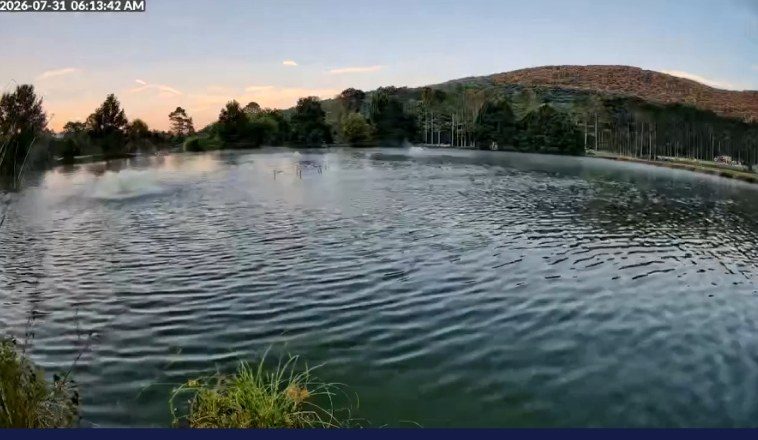
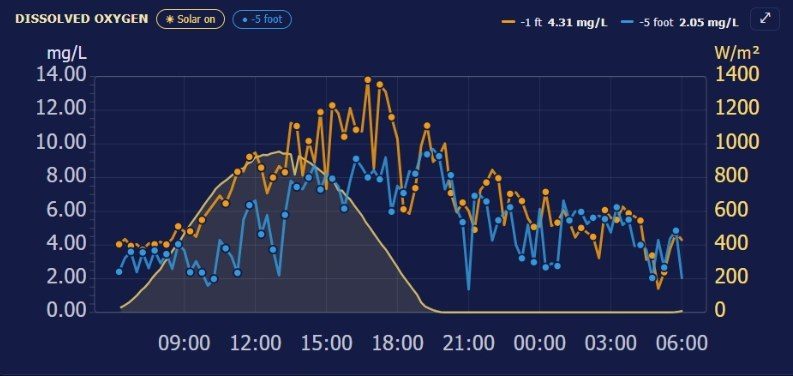
Watch the Slab Lab in real time — a live pond camera plus streaming dissolved oxygen at two depths, updated every 15 minutes.
DO now: 4.31 mg/L @ -1 ft · 2.05 mg/L @ -5 ft
Watch the Slab Lab LIVE