
Dissolved oxygen is the foundation of every healthy pond — and the first thing to collapse when it isn’t.
Aeration is the process of increasing dissolved oxygen in water by promoting contact between the water and the atmosphere. In a pond or lake, that means mechanically moving water so that oxygen-depleted water reaches the surface, exchanges gases with the air, and returns to the water column carrying dissolved oxygen.
Dissolved oxygen (DO) is the single most critical water quality parameter in any aquatic ecosystem. Every living organism in the pond depends on it: fish need it to breathe, beneficial aerobic bacteria need it to decompose organic matter, zooplankton and invertebrates need it to survive and reproduce, and the chemical stability of the sediment itself depends on oxygen being present at the bottom. When dissolved oxygen collapses, everything collapses with it.
In a natural, low-nutrient lake, wind and temperature dynamics provide enough mixing to maintain adequate oxygen levels. But in a managed pond — especially one with heavy feeding programs, elevated nutrient loads, or dense algae populations — natural processes are not sufficient. The biological oxygen demand (BOD) in these systems far exceeds what passive diffusion can supply. Aeration becomes not just beneficial but essential.
Aeration does more than just add oxygen. Properly designed aeration systems circulate the entire water column, preventing thermal stratification, stabilizing water chemistry, supporting aerobic decomposition of organic muck, and maintaining the conditions that keep nutrients locked in the sediment rather than releasing into the water to fuel algae blooms. It is the single most impactful mechanical intervention a pond owner can make.
Oxygen dissolves into water from the atmosphere, but the amount that can dissolve is limited by temperature and atmospheric pressure. Cold water holds significantly more dissolved oxygen than warm water. At 50°F (10°C), water at sea level can hold approximately 11.3 mg/L of dissolved oxygen at saturation. At 85°F (29°C) — a typical midsummer pond temperature in the South — saturation drops to approximately 7.6 mg/L.
This means that during the hottest months of the year, when biological oxygen demand is at its highest (warm temperatures accelerate microbial metabolism), the water's capacity to hold oxygen is at its lowest. This is the fundamental reason summer is the danger zone for fish kills: the oxygen supply ceiling drops while the oxygen demand floor rises. Aeration bridges that gap by continuously moving water to the surface for gas exchange, maximizing the amount of oxygen the water can hold at any given temperature.
One of the most dangerous conditions in a pond is one you cannot see from the surface: thermal stratification. Understanding how it forms, what it does, and how it kills fish is essential for any pond owner managing a fishery.
During warm months, the sun heats the surface water while deeper water remains cooler. Over time, this creates distinct temperature layers. The warm upper layer is called the epilimnion. The cold bottom layer is called the hypolimnion. Separating them is a narrow transition zone called the thermocline, where temperature drops rapidly with depth.
The thermocline acts as a physical barrier. Because warm water is less dense than cold water, the layers resist mixing. The surface water circulates with wind and wave action, but the bottom water becomes isolated — cut off from the atmosphere and from any source of oxygen replenishment.
With no oxygen supply from above, the hypolimnion begins to die. Aerobic bacteria consuming organic matter on the bottom use up whatever dissolved oxygen remains. Within weeks — sometimes days in a highly productive pond — the bottom water goes completely anoxic (zero dissolved oxygen). This triggers a cascade of chemical changes: iron-bound phosphorus in the sediment releases into the water column, hydrogen sulfide (the rotten-egg gas) accumulates, and ammonia levels spike as decomposition shifts from aerobic to anaerobic pathways.
From the surface, the pond may look perfectly normal. But below the thermocline, it has become toxic.
Turnover occurs when a weather event — a cold front, a heavy thunderstorm, sustained high winds — breaks the thermocline and forces rapid mixing of the entire water column. When this happens, the oxygen-depleted, toxic bottom water suddenly mixes with the surface water. Dissolved oxygen crashes throughout the entire pond, hydrogen sulfide and ammonia are distributed everywhere, and fish have nowhere to escape.
This is the mechanism behind many summer fish kills. The pond didn't run out of oxygen gradually. It experienced a sudden, catastrophic mixing event that overwhelmed the system in hours.
Aeration prevents stratification from forming in the first place. By continuously circulating water from the bottom to the surface, a properly sized aeration system eliminates the temperature layers that create the conditions for turnover. The entire water column stays mixed, oxygenated, and chemically stable.
Stratification risk increases significantly with depth. Shallow ponds (under 6 feet) are less likely to develop strong, persistent thermoclines because wind and surface disturbance can reach the bottom more easily. Ponds in the 6 to 10 foot range are in a transitional zone — they can stratify during prolonged calm, hot periods but may mix naturally with moderate weather events. Ponds deeper than 10 feet are highly prone to stable stratification that persists for weeks or months during summer.
However, depth alone doesn't determine risk. Pond shape (steep-sided vs. gradually sloping), surface area relative to depth, wind exposure, surrounding tree cover, and nutrient loading all play roles. A shallow, heavily fed pond with dense algae growth can develop dangerous dissolved oxygen conditions even without classical thermal stratification, simply due to the biological oxygen demand exceeding the system's ability to replenish.
Dissolved oxygen is measured in milligrams per liter (mg/L). The number itself is simple; the dynamics behind it are anything but. Understanding not just the threshold but the daily swing pattern — especially in nutrient-rich ponds — is what separates reactive pond management from proactive pond management.
| DO Level (mg/L) | Condition | Impact on Aquatic Life |
|---|---|---|
| > 7.0 | Excellent | Optimal for fish growth, reproduction, and food web health. Supports full invertebrate and zooplankton communities. |
| 5.0 – 7.0 | Adequate | Sufficient for most warm-water species. Some sensitive invertebrates may be reduced. Target minimum for managed fisheries. |
| 3.0 – 5.0 | Stressed | Fish stop feeding, growth slows, susceptibility to disease increases. Benthic invertebrate communities degrade significantly. |
| 1.0 – 3.0 | Critical | Fish kills likely, especially for sensitive species. Aerobic decomposition slows dramatically. Nutrient release from sediment accelerates. |
| < 1.0 | Anoxic | Fish kill imminent. Anaerobic conditions produce hydrogen sulfide and ammonia. Iron-bound phosphorus releases from sediment. |
In a heavily nutrient-loaded (hypereutrophic) pond, dissolved oxygen doesn't just sit at a steady number. It swings — dramatically — over a 24-hour cycle, and understanding this swing is critical to understanding why fish kills happen even in ponds that seem fine during the day.
During daylight hours, the dense algae population is photosynthesizing at maximum capacity. This produces massive amounts of oxygen — often pushing dissolved oxygen well above saturation, sometimes to 15 mg/L or higher. A pond owner checking DO at 2:00 PM on a sunny day might see readings that look spectacular. The water seems alive. The fish are active. Everything looks great.
But at sunset, photosynthesis stops. The oxygen faucet turns off.
Now every organism in that water — the same dense algae population that was producing oxygen all day, plus every bacterium, every zooplankton, every fish — switches to respiration only. They are all consuming oxygen and nothing is producing it. In a hypereutrophic system, the biological oxygen demand is enormous because the very thing that produced so much oxygen during the day (the massive algae biomass) is now consuming it through respiration all night long.
The result is a steep, sustained decline in dissolved oxygen from sunset through the overnight hours, reaching its lowest point in the pre-dawn window — roughly 4:00 to 7:00 AM. In a heavily loaded system, DO can drop from supersaturation at sunset to below 2 mg/L before sunrise. That's a lethal crash that happens every single night, invisible to anyone who only checks their pond during the day.
Add a cloud cover event (reducing photosynthesis during the day before the crash), unusually warm overnight temperatures (reducing oxygen solubility while increasing metabolic demand), or a die-off of the algae population itself (which eliminates the oxygen source while dramatically increasing decomposition demand), and you have the recipe for a catastrophic fish kill.
Aeration is the overnight safety net. A properly sized aeration system continuously moves water to the surface for atmospheric gas exchange, supplementing the oxygen supply when photosynthesis can't. It doesn't eliminate the swing, but it compresses it — keeping the overnight low above the critical threshold where fish start dying.
The 24-hour pattern of dissolved oxygen rise and fall is called a diel oxygen curve. In a balanced, mesotrophic pond, the daily swing might be modest: perhaps 7 mg/L in the early morning rising to 9 mg/L in the late afternoon. In a hypereutrophic system, that same cycle might range from 2 mg/L pre-dawn to 18 mg/L mid-afternoon — a swing of 16 mg/L in a single day.
Continuous DO monitoring, like the real-time water quality buoy used at the Slab Lab, captures this full curve and provides early warning when overnight lows start trending downward. A single daytime DO measurement can be dangerously misleading because it only captures the system at or near its daily peak. Effective fishery management requires understanding the entire cycle — especially the overnight minimum.
When interpreting DO data, the most important number isn't the afternoon peak. It's the pre-dawn minimum. If that number is trending toward 4 mg/L, the system is already in a precarious position — one warm, still night away from a crash that could push it below the survival threshold.
Not every device that moves water qualifies as effective aeration. The distinction between lateral surface movement and true vertical mixing is one of the most important and most misunderstood concepts in pond management.
Paddle wheel aerators are common in aquaculture. They sit at the surface and spin paddles that push water horizontally across the pond. They create visible surface disturbance and some splashing, which does introduce a degree of atmospheric oxygen exchange at the immediate surface. They are relatively inexpensive and widely available.
The problem is what they don't do. Paddle wheels move water laterally — across the surface — without inducing meaningful vertical circulation. They don't pull water from the bottom of the pond. They don't break thermal stratification. They don't circulate the entire water column. The water at the bottom of a paddle-wheel-aerated pond can remain stagnant, oxygen-depleted, and chemically reducing while the surface appears agitated and well-oxygenated.
In a shallow, well-mixed pond, this limitation may not be critical. But in any pond with significant depth, nutrient loading, or fishery management goals, paddle wheels leave the most dangerous water — the bottom water — untouched.
Effective pond aeration requires vertical mixing: physically moving water from the bottom of the pond to the surface, where it contacts the atmosphere and exchanges gases. This is fundamentally different from what a paddle wheel does.
Surface aerators (like the Kasco AF Series) achieve this by sitting at the surface and drawing water upward in a powerful vertical column, then throwing it into the air. The water rises from below, gets exposed to the atmosphere, absorbs oxygen, and falls back to the surface, creating a continuous circulation pattern that reaches down into the water column.
Bottom diffused systems (like the PowerAir or Robust-Aire) achieve vertical mixing from the opposite direction. A shore-mounted compressor pumps air through tubing to diffuser plates sitting on the pond bottom. As air is released from the diffuser, rising columns of bubbles entrain and lift water from the bottom to the surface. The critical mechanism here is not the bubbles themselves dissolving oxygen into the water — the bubbles are the engine, not the oxygen source. Their primary role is to lift deep water to the surface, where it contacts the atmosphere and exchanges gases naturally. This circulation of actual water volume from bottom to top is what destratifies the pond and exposes the entire water column to atmospheric oxygen.
Moves water horizontally across the surface. Does not induce vertical circulation. Bottom water remains stagnant and oxygen-depleted. Limited destratification benefit.
Moves water vertically — bottom to surface. Full water column circulation. Breaks stratification. Exposes all water to atmospheric oxygen exchange.
At the Slab Lab, this difference was visible from day one. When the Kasco 3.1AF surface aerators replaced the old paddle wheel, the team immediately observed that 3 horsepower of true vertical mixing was producing comparable visible water movement to 10 horsepower of horizontal paddle wheel action — with the added benefit of actually circulating the entire water column. The paddle wheel was shut off permanently.
There are four main categories of aeration and water movement equipment for ponds. Each serves a different primary purpose, and choosing the right one depends on your pond's depth, your management goals, and your budget.
Surface aerators are purpose-built for oxygen transfer and vertical mixing. They float at the surface and use a high-efficiency motor to draw water upward and propel it into the air, creating a powerful boil pattern. The Kasco AF Series is engineered specifically for aeration performance — not aesthetics — and delivers the highest oxygen transfer rates per horsepower of any surface-mounted option.
Surface aerators are the recommended choice for ponds 8 feet deep or shallower where the primary goal is dissolved oxygen management and water column circulation. In these shallower systems, the vertical mixing pattern from a surface aerator can effectively reach the bottom, eliminating stratification and maintaining oxygenated conditions throughout.
SLABLAB at shop.naturalwaterscapes.com for $20 off orders over $100.
Bottom diffused systems are the gold standard for ponds deeper than 8 feet. A compressor sits on shore and pumps air through weighted tubing to diffuser plates resting on the pond bottom. The rising columns of bubbles entrain surrounding water and lift it to the surface, creating a continuous circulation pattern that destratifies the entire water column.
Remember: the primary oxygenation mechanism is not the bubbles dissolving into the water. The bubbles are lifting bottom water to the surface, where atmospheric gas exchange occurs. This means the entire volume of the pond is gradually cycled through the surface, exposed to the atmosphere, and returned — carrying dissolved oxygen all the way back to the bottom.
The PowerAir systems are our house brand of bottom diffused aeration, built with Wispr quiet rocking piston compressors that are nearly silent in operation — an important consideration when equipment is installed near homes, docks, or recreational areas. The Kasco Robust-Aire is an excellent alternative with proven reliability.
If your pond is already thermally stratified with an oxygen-depleted bottom layer, do not run a new bottom aeration system continuously from the start. Rapid destratification can release accumulated hydrogen sulfide, ammonia, and other toxic compounds all at once — essentially triggering the same turnover event aeration is designed to prevent. Start with short intervals (a few hours per day) and gradually increase runtime over one to two weeks, allowing the bottom water to be slowly incorporated and oxygenated without shocking the system.
SLABLAB at shop.naturalwaterscapes.com for $20 off orders over $100.
The Kasco VFX Series sits between a pure aerator and a decorative fountain. It creates a V-shaped spray pattern that provides genuine aeration value — meaningful oxygen transfer and surface agitation — while also delivering an attractive visual display. For pond owners who want functional aeration but also care about the aesthetics of their water feature, the VFX is a strong middle ground.
The VFX will not match the raw oxygen transfer performance of a dedicated AF Series aerator at the same horsepower, but it provides significantly more aeration than a decorative fountain. It's a good option when budget allows only one unit and the owner wants both function and form.
The Kasco J-Series are decorative fountains first. They create beautiful spray patterns (five interchangeable nozzles included) and are an excellent choice for HOA ponds, golf courses, parks, or anywhere visual appeal is the top priority. They do provide some surface agitation and oxygen transfer, but their primary design goal is aesthetics, not aeration performance.
For fishery management, J-Series fountains should be paired with a dedicated aeration system — either surface aerators or bottom diffused — if dissolved oxygen management is a priority. A J-Series alone will not provide adequate oxygenation for a pond with significant nutrient loads or fish populations, particularly in ponds deeper than 6 feet.
The single most important factor in choosing an aeration system is pond depth. Everything else — acreage, fish load, nutrient level — helps you size the system, but depth determines which type of system will work.
| Pond Depth | Recommended System | Why |
|---|---|---|
| ≤ 8 feet | Surface Aerator (AF Series) | Vertical mixing from a surface unit can reach the bottom. Full water column circulation. Maximum oxygen transfer per HP. |
| > 8 feet | Bottom Diffused (PowerAir) | Rising bubble columns lift bottom water to surface from any depth. Complete destratification. Prevents anoxic bottom conditions. |
| Any depth | VFX Series (budget hybrid) | When the owner wants both aeration and visual display from one unit. Best for light to moderate nutrient loads. |
| Any depth | J-Series + dedicated aeration | When aesthetics are the primary need. Always pair with a dedicated aeration system for fishery management. |
Beyond depth, the key sizing factors include surface acreage (larger surface area requires more horsepower to achieve adequate circulation), nutrient loading (heavier loads create higher biological oxygen demand), fish density (more fish means more oxygen consumption), and pond shape (irregular shapes may need multiple units for coverage).
Our team sizes aeration systems based on your specific pond characteristics. A conversation with one of our pond experts will get you to the right system faster than any online calculator.
Every pond is different. Our team can help you select and size the right aeration system based on your pond's depth, acreage, fish population, and management goals. No guesswork.
Aeration and phosphorus management are deeply intertwined. Understanding why requires knowing one critical fact about sediment chemistry: oxygenated sediment locks phosphorus in place; anoxic sediment releases it.
In the sediment at the bottom of every pond, phosphorus is bound to iron compounds (ferric phosphate). As long as dissolved oxygen is present at the sediment-water interface, that bond remains stable. The phosphorus stays locked in the sediment, unavailable to algae.
But when the bottom water loses oxygen — whether from stratification, overnight DO crashes, or insufficient aeration — the iron changes its chemical state (from oxidized Fe³⁺ to reduced Fe²⁺), and the bond breaks. Phosphorus floods back into the water column in a process called internal loading. This released phosphorus is immediately bioavailable, fueling the very algae blooms and cyanobacteria populations that create the high biological oxygen demand that drives the DO down further. It's a vicious, self-reinforcing cycle.
Aeration breaks that cycle. By maintaining dissolved oxygen at the sediment-water interface, a properly sized aeration system keeps the iron-phosphorus bond intact, reducing internal nutrient loading and depriving algae of their primary fuel source.
Depth, volume, and dissolved oxygen over time drive every aeration choice. MyPond builds your bathymetric profile, calculates volume, and tracks DO so you can size and monitor aeration with confidence.
Know Your Pond — Start Free → Free for up to 3 ponds · No credit card requiredThis is why the Slab Lab reset combined both approaches: MetaFloc to bind the estimated 1,000+ pounds of reactive phosphorus in the sediment, and Kasco 3.1AF surface aerators to maintain the oxygenated conditions needed to keep that phosphorus locked in place going forward.
The Slab Lab is a 3-acre trophy bluegill pond in Alabama that suffered a catastrophic fish kill in the summer of 2024. The recovery — documented across a YouTube series by Natural Waterscapes — involved a complete reset of the pond's water chemistry, biology, and aeration infrastructure. The aeration upgrades were a centerpiece of that effort.
Before the Reset: The Slab Lab relied on paddle wheel aerators. Despite significant horsepower (10 HP), the paddle wheels moved water laterally across the surface without creating the vertical circulation needed to destratify the water column or oxygenate the sediment-water interface. Bottom water quality degraded, internal phosphorus loading continued unchecked, and dissolved oxygen swings became severe — culminating in the fish kill.
The Upgrade: During the reset, the team installed two Kasco 3.1AF (3 HP) surface aerators, strategically placed to maximize circulation coverage across the pond. From the moment the first unit fired up, the difference was immediately apparent. Three horsepower of true vertical mixing moved a comparable volume of water to the 10 HP paddle wheel — but critically, it was moving water vertically, drawing from below the surface and exposing the full water column to atmospheric oxygen exchange.
The Result: The paddle wheel was permanently shut off. The Kasco 3.1AF units now provide continuous dissolved oxygen management, monitored around the clock by a real-time water quality buoy with a hard threshold of 5 mg/L. Combined with the MetaFloc phosphorus treatment, the aeration upgrade is a core pillar of the Slab Lab's rebuilt ecosystem — supporting aerobic decomposition, stabilizing sediment chemistry, and protecting the food web that will feed the next generation of trophy bluegill.
Low dissolved oxygen results from a combination of factors: thermal stratification that isolates bottom water from the atmosphere, excessive biological oxygen demand from decomposing organic matter and dense algae populations that consume oxygen overnight through respiration, warm water temperatures that reduce oxygen solubility, and calm conditions with no wind or mechanical mixing. In hypereutrophic ponds with heavy nutrient loads, dissolved oxygen can swing from supersaturation during the day to near-zero before dawn — making the pre-dawn hours the most dangerous window for fish kills.
Surface aerators float at the water surface and draw water upward in a vertical column, throwing it into the air for atmospheric gas exchange. They are most effective in ponds 8 feet deep or shallower. Bottom diffused aeration uses a shore-mounted compressor to pump air through tubing to diffuser plates on the pond bottom. The rising columns of bubbles lift bottom water to the surface, circulating the entire water column. The bubbles are the engine — the actual oxygen transfer occurs at the surface-atmosphere interface. Bottom diffused systems are recommended for ponds deeper than 8 feet where surface aerators cannot effectively reach the bottom.
Most warm-water fish species require a minimum of 4-5 mg/L of dissolved oxygen to avoid stress. Below 3 mg/L, fish become severely stressed, stop feeding, and become susceptible to disease. Below 1-2 mg/L, fish kills occur. For a managed trophy fishery, maintaining dissolved oxygen above 5 mg/L at all times — including the critical pre-dawn minimum — is the standard target.
Thermal stratification occurs when the sun heats surface water while deeper water stays cold, creating distinct temperature layers. The bottom layer (hypolimnion) becomes isolated from atmospheric oxygen and eventually goes anoxic. When a weather event — a cold front, thunderstorm, or sustained winds — breaks the thermocline and forces rapid mixing (turnover), the oxygen-depleted bottom water mixes throughout the pond, crashing dissolved oxygen and potentially killing fish. Aeration prevents stratification from forming by continuously circulating the entire water column.
For ponds 8 feet deep or shallower, surface aerators (like the Kasco AF Series) are generally more effective and practical. The vertical mixing pattern from a surface aerator can reach the bottom in shallow water, providing both aeration and full water column circulation. Bottom diffused systems require sufficient depth for the rising bubble column to develop effective circulation patterns — in very shallow ponds, the short rise distance limits the circulation benefit.
No — caution is essential. If your pond is already heavily stratified with an anoxic bottom layer, rapid destratification can release accumulated hydrogen sulfide, ammonia, and other toxic compounds all at once, while mixing oxygen-depleted water throughout the pond. This is essentially a mechanical turnover event. The safe approach is to start the system gradually: run it for short intervals (a few hours per day) and increase runtime over one to two weeks. This allows the bottom water to be slowly incorporated and oxygenated without shocking the system.
Aeration is one piece of the puzzle. Explore the other factors that determine whether a pond thrives or declines.
Watch the full Slab Lab video series on YouTube — from fish kill to aeration install to food web recovery, every step documented.
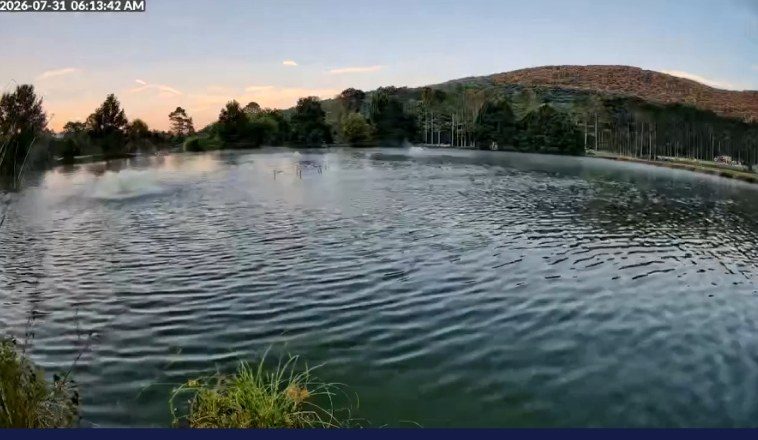
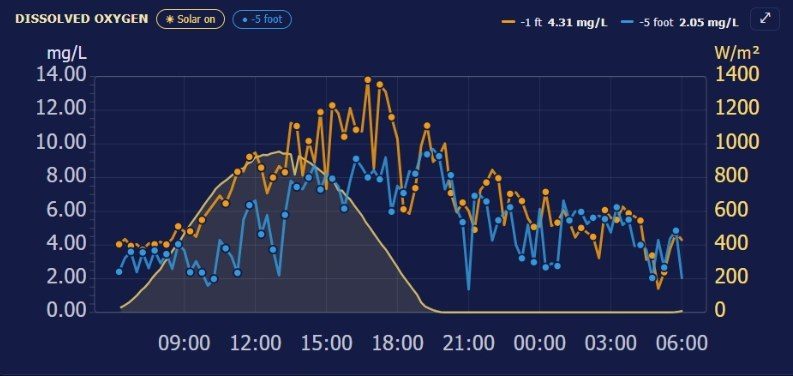
Watch the Slab Lab in real time — a live pond camera plus streaming dissolved oxygen at two depths, updated every 15 minutes.
DO now: 4.31 mg/L @ -1 ft · 2.05 mg/L @ -5 ft
Watch the Slab Lab LIVE